
Subhas Chandra Bose or Shyama Prasad Mukherjee? BJP Is Trying to Rivet New Icon In West Bengal
Shubham Sharma
Bharatiya Janata Party’s (BJP) resounding victory in the West Bengal assembly elections has prompted the declaration of new heroes for Bengal. The new Finance Minister of West Bengal, historian Swapan Dasgupta, is leading the effort. He and his party are trying to create a new myth around Shyama Prasad Mukherjee, the leader of the Hindu Mahasabha and later the Bharatiya Jan Sangh, hailing him as the real hero of (West) Bengal.
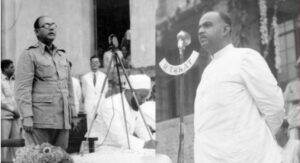
Every new wave of myth-making around any new hero in Bengal, especially in politics, will have to crash against the sturdy legacy of Netaji Subhas Chandra Bose. In Shyama Prasad’s case, this is even more obvious, as he was Netaji’s exact contemporary in politics.
Shyama Prasad belonged to the right-wing communal strand of politics, whereas Subhas Bose, whom Gandhiji called ‘the Prince among Patriots’, belonged to the left-wing anti-colonial strand. Subhas Bose took the ideological labels of ‘left’ and ‘right’ very seriously. In his book The Indian Struggle, he identified himself with the left, who, in his words, ‘‘(held) radical views on social and economic questions, i.e., questions relating to caste, to landlord versus peasant and to capital versus labour.’’
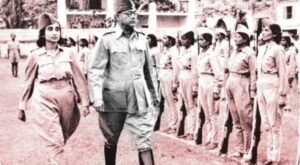
For Nehru, whom Bose called a ‘full-blooded socialist’, Bose wrote: ‘‘while his brain is with the Left Wingers, his heart is with Mahatma Gandhi.’’ Needless to say, in Bose’s ideological continuum, Shyama Prasad and the Hindu Mahasabha ended up on the extreme right, who did not take the socio-economic questions of caste, peasant versus landlord and capital versus labour seriously.
The Hindu right in colonial India also lagged behind the likes of Subhas Bose and Jawaharlal Nehru, and the left (broadly defined) in terms of its commitment to anti-colonial politics. Neither Shyama Prasad and his party, the Hindu Mahasabha, nor the Rashtriya Swayamsevak Sangh (RSS) ever passed a formal resolution for independence from the British, as did the Indian National Congress at its Lahore Session in 1929.
The chief reason for the Hindu right’s reluctance to do so was its definition of nationalism. Unlike Bose, for whom Indian nationalism was being forged in joint opposition to British rule, Shyama Prasad and his ecosystem defined Indian nationalism in purely Hindu terms and in opposition to the religious minorities, considered outsiders, chiefly the Muslims. This chain of reasoning unites all proponents of Hindu nationalism, or ‘Hindutva’, from the pre-independence period to the present.
Subhas Bose not only despised this brand of politics but was ready to use physical force against them in Bengal. It is a matter of historical record that his supporters attacked and dismantled the meetings of the Hindu Mahasabha in Bengal. In one such scuffle, Shyama Prasad was also physically injured. Subhas Bose and his brother rose in the Bengal Congress as radicals committed to abolishing zamindari and pursuing pro-poor reforms.
The right-wing within the Bangla Congress, the Bangiya Barahman Sabha, and later the Hindu Mahasabha became their main ideological opponents. Subhas Bose learnt his first lessons in politics at the feet of Deshbandhu Chittaranjan Das, for whom the political uplift of the Bengali Muslims was paramount. The Bengal Pact was an important milestone in this regard.
Subhas Bose was convinced that both India and Bengal had no future without Hindu-Muslim unity. The reason for this insistence also had personal roots. Unlike the Hindu right’s vision of eternal strife between the Muslim dynasties that ruled India and the Hindus, Bose saw the past as a composite whole where Hindus were as much members of the ruling class as the Muslims. own ancestors served the pre-Mughal Muslim sultans in Bengal.
One of his ancestors, Mahipathi, was given the title Subuddhi Khan (Subuddhi meaning good counsel) by the Sultan. Mahipathi’s grandson, Gopinath Bose, became a minister in charge of finance and the navy during the rule of Sultan Hussain Shah (1493-1519) and acquired the title of Purandar Khan. During his youth, he was influenced by an eclectic mix of Swami Vivekananda, Adi Shankaracharya, the Brahmo movement, non-conformist Christians and even Hegel.
When the Hindu Mahasabha was inaugurated in Bengal, much to the chagrin of Subhas Bose, the viceroy Linlithgow waxed eloquent and his masters in London that ‘‘I will not be surprised, things being as they are, if the Mahasabha were to succeed in stealing a certain amount of Congress thunder.’’ As the war started, the British provided a fillip to communal organisations such as the Hindu Mahasabha and the Muslim League. In Bengal, Subhas Bose sensed the ramifications of this more than anyone. After the Muslim League’s Lahore Resolution in March 1940, Muslim opinion in Bengal began to gravitate towards it.
Subhas Bose tried to forge Hindu-Muslim unity in Bengal by a new variation of C.R. Das’s Bengal Pact. In a last-ditch effort, he aimed to bring Hindus and Muslims together against the British before the largely non-League Muslims were swayed completely by the League’s communal program. He expressed this view explicitly to the Krishak Praja Party leader Abdul Mansur Ahmed. Bose forged an alliance between the Muslim League and the Muslim League in the election to the Calcutta Corporation in April 1940.
The alliance swept the polls, and Bose himself declared the name of Abdur Rahman Siddiqui, leader of the Bengal Muslim League, for the Mayor’s post. Would it have been possible for the charismatic and uncompromising Subhas Bose to stem the tide of communalism in Bengal before his departure from India in 1941? This is an interesting historical counterfactual.
What is more important for our context is that Shyama Prasad was present in Bengal politics, and his efforts did more to fan the Hindu-Muslim divide than stem it. For instance, in September 1939, Shyama Prasad presided over a meeting of the Bharat Sevashram Sangha attended by 2,600 people. The meeting urged Bengali Hindus to develop their physiques, carry sticks, abandon non-violence, and cultivate paurusha (strong manhood).
The political economy of Bengal, in which Hindu zamindars were pitted against a predominantly Muslim peasantry, also played a major role in shaping the contours of Bengal politics. Economy and identity were intertwined in a manner that made emancipation not always immune to communal undertones. After Subhas Bose’s departure, there was no one left in Bengal to prevent the complete communalization of politics.
Even while away on his larger mission, Bose did much to forge Hindu-Muslim unity. He adopted Tipu Sultan’s springing tiger on the flag of the Azad Hind Fauj, named a brigade in the Azad Hind Fauj after Maulana Abul Kalam Azad, adopted three Urdu words, Itmad (Faith), Ittefaq (Unity), and Kurbani (Sacrifice) as slogans for his army, and had Muslims as the top commanders of the Azad Hind Fauj.
He also visited the grave of Bahadur Shah Zafar in Burma and hailed him as the ‘‘last fighter for India’s freedom.’’ He further said: ‘‘The man who was an Emperor among men and at the same time a man among Emperors. We cherish the memory of Bahadur Shah. We Indians, regardless of religious faiths, cherish his memory not because he was the man who gave the clarion call to his countrymen…but because he was the man under whose flag fought Indians professing all religious faiths.’’
The trials of the Azad Hind Fauj prisoners led to a unity, albeit short-lived, among the Congress, the Muslim League and the Communists. On 22 November 1945, the entire working class of Calcutta went on strike. The Amrita Bazar Patrika depicted it as a national revolt to end British rule in India, driven primarily by Subhash Bose’s Azad Hind Fauj.
No such history of secular, anti-colonial nationalism could be associated with Shayma Prasad’s politics. Bengal needs no new heroes; Bengali secularism has a giant in Subhas Bose; it needs no new midgets.
(The author is a research scholar.)
पश्चिम बंगाल के असली हीरो कौन : सुभाष चंद्र बोस या श्यामा प्रसाद मुखर्जी?

